


In Siberia, the bridge where China and Russia meet
Updated: Jan 7, 2025
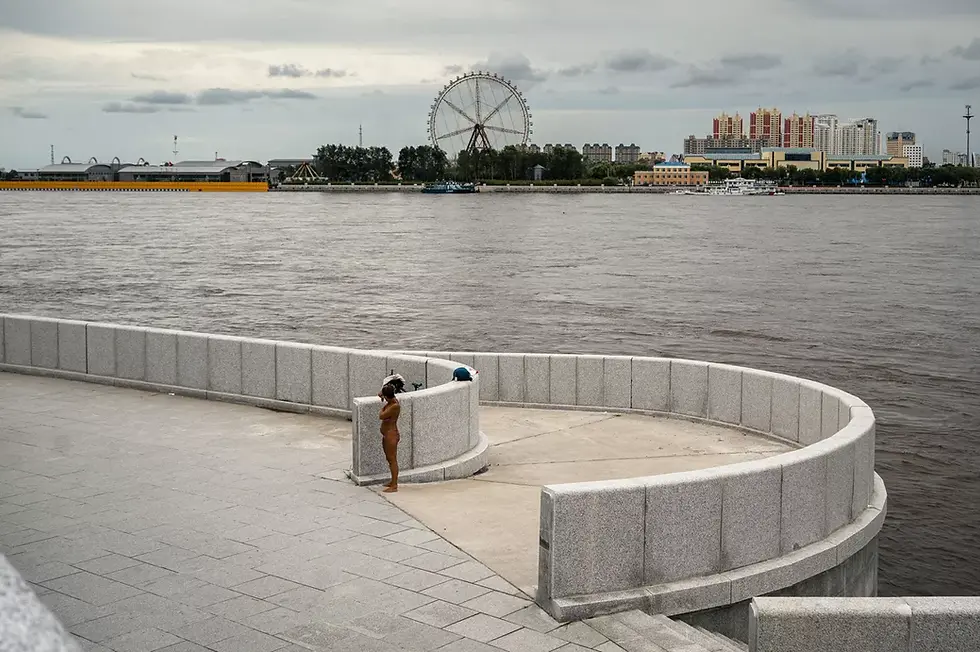
China northeastern border town Heihe has seen bilateral trade skyrocketed with it’s neighbour and former enemy.
Sebastien Falletti, in Heihe
Along the ribbon of tarmac, gleaming blue and apple-green bodies glisten in the spring sunshine that crushes the countryside overgrown with taiga birch. Around a hundred brand-new trucks, emblazoned with a picture of a friendly bear, wait silently in line for their future destination, after being manufactured in the heart of the "world factory". "These lorries will go to Russia," explains this resident of Heihe, pointing in the direction of the Friendship Bridge.
The bridge spans the River Amur, which forms the north-eastern border with China, on the outskirts of this sentinel town of 1.2 million inhabitants in the province of Heilongjiang. This slender structure with its bright red pillars symbolises the new geopolitical honeymoon between the two Eurasian giants, reaffirmed by Vladimir Putin's state visit. The Russian president is heading for Harbin, the provincial capital, on Friday, following a reception with great fanfare by President Xi Jinping in Beijing.
Inaugurated in 2022, this first road bridge between China and Russia illustrates the surge in bilateral trade since the war in Ukraine, as Moscow pivots towards Asia under the pressure of Western sanctions. Long a sea serpent mired in Russian procrastination, the bridge has finally emerged to become a showcase for the "unlimited partnership" sealed by the "Tsar" and the "Red Emperor", in search of alternative supply chains. The surge in bilateral trade, which reached 240 billion dollars last year, 90% of which is denominated in yuan or roubles, has become an anti-sanctions shield, protecting this trade "from pressure from third countries", said a delighted Putin on Thursday.
From the observation deck overlooking the ochre-coloured waters of the immense Siberian river, binoculars show a line of brand new yellow diggers and bulldozers waiting at the Russian customs clearance post on the other bank. Just a stone's throw away, a Russian executive with auburn hair and an elegant mauve suit watches the spectacle, led by her Chinese counterpart in a black parka and white shirt, the uniform of choice for Chinese Communist Party officials. The delegation is on its way to Harbin, 560 km to the south, where Putin is celebrating 75 years of "hard-won" friendship, which must be "cherished and nurtured", according to his colleague Xi.
A muted past
Heihe is taking full advantage of this new crossing point, having recorded a 59% increase in its foreign trade and a 98% rise in its exports last year, according to official statistics. "Relations have been very good since the war in Ukraine. Russia needs China. We export our machinery to them, and there are mines and fields there," enthuses Mr Zhang (*), as he watches his fishing rod planted in the sandy bank of the river in the setting sun.
On the opposite bank, 750 metres away, the greyish buildings and chimney stacks of Blagovechtchensk, a town of 250,000 inhabitants, rise above a gigantic Russian flag. So far, so near.
During the Siberian winter, when the mercury drops to minus 30 degrees, it's even possible to cross the frozen river on foot, but intimidating barbed wire and armed soldiers forbid passage. This is a relic of the cold war that brought the two former Communist bloc rivals to the brink of nuclear conflict at the end of the 1960s, at the height of Maoist hysteria, putting the remote Heilongjiang region in the front line.
This bitter past is now being played down by propaganda, with red banners calling for
"Sino-Russian friendship through trade" at the entrance to the city's free trade zone, built on an island overlooked by the star-spangled red banner of the People's Republic. A cable car is even planned to link the two shores and boost the flow of tourists who currently use the ferry. Inside the three-storey complex, the Epinduo wholesale supermarket offers an avalanche of products from the former Soviet area, from Baltika beer to Alënka chocolates and Georgian 'Stalin' wine, bearing the effigy of the dictator.
Russia a new Eldorado?
"Russian products have been very popular since Covid," explains one shop assistant. In the city, shops sell fox chapkas, fake cognacs and real Beluga vodkas, as well as pharmaceutical miracle cures made from bear or wolf fat, supposed to cure "tuberculosis", and wild sea cucumbers that are very popular in Shanghai and Beijing.
"I go to Russia every two or three days to bring back goods", explains the owner in the fluorescent jumper, who exports her finds all over China. It's a promising career path for Iliana, the name chosen by this 3rd year Russian language student, whose nails are carefully painted pink. "I want to study in Moscow or St Petersburg. There are lots of business opportunities there at the moment."
The people of Heihe look to the other shore with a new look of mixed curiosity and condescension, as Greater China gains the upper hand over its long invading neighbour. "I want to go and see," explains Fan (*), a retired man with a craggy complexion who has just obtained his first passport at the age of 56 and who makes no secret of his admiration for "Putin Dadi" (Emperor Putin). "He's a very strong leader who knows how to command respect.
On Douyin, the local version of TikTok, videos of enticing young Russian women with the sweet name of Natacha declaring their desire to meet "Chinese men" have gone viral, triggering cackles of pleasure from some nationalist accounts and disgust from feminists. These images are in fact faked by artificial intelligence, and are intended to support online scams.
The manipulation, officially denounced by Chinese web regulators, and the success of these videos illustrate the new superiority complex with regard to the former Soviet big brother. In Heihe, every morning, tour operators take Chinese tourists on board speedboats for a taste of elsewhere, with a stop in a restaurant to sample 'Russian' sausages , still described as 'Ukrainian' on some menus. Young people are more circumspect, and some look with disdain on a neighbour who is now considered to be lagging behind. "Honestly, there's nothing to see over there. Our cities are much richer", explains a young woman taking her evening stroll along the river.
A bloody history along the river
A sign of the times, the imposing circular shopping complex offering Chinese products to Russian tourists has now been abandoned. It was built in 2008, at a time when Russia's new middle class liked to come and spend its roubles with its exotic neighbour, which was so cheap at the time. "The Russian economy is in a bad way because of the war. Households are burning through their wages and can no longer afford to come here to spend", points out the Epinduo saleswoman. Now, gleaming diggers made in Jiangsu await their Russian customers in the building's car park. After surging by 46% in 2023, Chinese exports are showing the first signs of a slowdown at the start of this year, slowing in March and April.
Several Chinese banks have cut ties with their Moscow customers, while the United States is threatening to sanction entities that support the war effort in Ukraine. This warning has been taken seriously by the world's second largest economy, which is also its biggest exporter, and whose development depends on its access to international markets. The partnership has many limits, and "is not without ulterior motives", as one diplomat points out.
30 km south of Heihe, a museum commemorates the "criminal" aggressions of Tsarist Russia, on the very spot where the Treaty of Aigun was signed in 1858, when the Qing dynasty was forced to cede more than 600,000 km2 of imperial China to the European powers. The humiliation was followed by the massacre of 5,000 people drowned in the Amur, the "river of the black dragon", as the Manchus call it. Territorial losses that have now been muted in the era of great Sino-Russian friendship, but never forgotten. "We'll be able to get them back the day China becomes powerful," says Fan, our pensioner, as he gazes out over the peaceful, meandering waters of the Amur.
(*) First and last names have been changed.
Copyright @lefigaro.fr
Here is the original article: https://www.lefigaro.fr/international/forger-l-amitie-sino-russe-par-le-commerce-sur-le-fleuve-amour-une-lune-de-miel-lourde-d-arriere-pensees-20240516


